
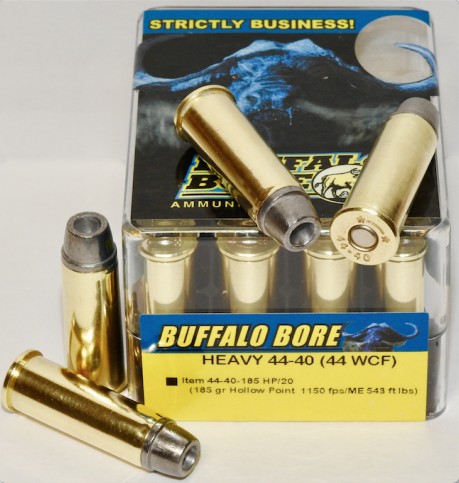

For nearly two decades, as of this writing (12-20-17), customers have requested full-power 44-40 loads. Due to the cartridge’s antiquity—originally developed in the mid-1800s for black powder—there are several challenges in creating modern full-power versions.
Original 200-grain lead bullets (not hard cast) achieved:
- Approximately 1,000 fps from 7.5-inch barreled revolvers
- Over 1,300 fps from rifles
Our updated loads match or exceed these velocities using smokeless powders, while remaining within the black powder pressure limit of 13,000 CUP (maximum average pressure).
In the 1800s, the gun and ammunition industry lacked standardized pressure ratings and firearm dimensions. This complicates the production of modern ammunition tailored to today’s specifications. Consider the following example:
- Early Colt revolvers had a bore diameter of .427 inches
- Some featured chamber throats of .423–.424 inches
- This design increased pressure and velocity by resizing soft lead bullets to seal the bore
Modern hard cast bullets are significantly harder than pure lead. If fired through revolvers with undersized chamber throats, they may not resize properly, potentially increasing pressure beyond what old iron-framed revolvers can handle.
Safety Warning: Do not use modern 44-40 ammunition in revolvers manufactured before 1900. By that time, manufacturers had transitioned from iron to steel construction, which is more suitable for higher pressures.
Another concern is the condition of older revolvers. Many are in poor shooting condition, making it risky to fire any ammunition. Shooters should:
- Have questionable firearms inspected by a competent gunsmith
- Understand that not all gunsmiths are equally qualified
- Take personal responsibility for firearm safety and education
Unfortunately, in modern America, individuals often neglect safety, and when accidents occur, they resort to litigation rather than acknowledging their own lack of preparation or responsibility.
Personally, I would avoid firing any ammunition from firearms originally built for black powder use. The 1894 Winchester chambered in 30-30 was the first American civilian firearm with barrel steel designed for smokeless powder pressures. By 1900, most manufacturers had adopted stronger steel for cylinders and barrels to accommodate higher pressures.
Item #44-40 185 HP features a softer hollow-point bullet compared to our 200-grain load. With a hardness rating of approximately 8–9 BHN, this bullet is engineered for expansion:
- Expands on impact at handgun velocities when striking flesh and bone
- Expands significantly at rifle velocities on similar tissues
- Penetration ranges from 18 to 24 inches in living mammalian tissue, depending on impact velocity and bone contact
- Uses flash-suppressed powder to reduce muzzle flash in low-light conditions
- Bullet diameter is .428 inches, ideal for bores ranging from .427 to .430 inches
- Soft enough to “slug up” under pressure and seal bores up to .431 inches
Tested velocities from various firearms:
- 1,471 fps – Winchester Model 1892, 20-inch barrel, circa 1916
- 1,470 fps – Uberti Model 1873, 19-inch barrel, circa 1997
- 1,171 fps – Ruger Vaquero (large frame), 7.5-inch barrel, circa 2003
- 1,199 fps – Colt New Service, 7.5-inch barrel, circa 1905
- 1,073 fps – S&W Model 544, 5.5-inch barrel, circa 1980s
- ??? fps – Custom SAA replica by Brian Pearce, 5.5-inch barrel, circa 2017
- 1,101 fps – Ruger converted .357 Mag. flat top by Jack Huntington, 4.75-inch barrel, circa 1959


