
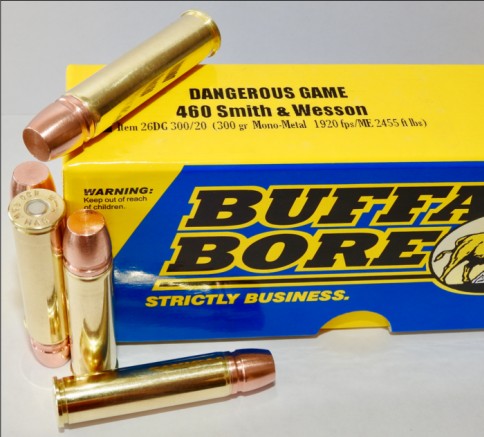

Mono-metal bullets have a few advantages (and a couple of disadvantages) over typical non-expanding hard cast bullets. These advantages may or may not be meaningful to each individual, depending on your usage.
- They are cleaner burning/firing than hard cast bullets.
- Hard cast bullets can smear their nose profile when they hit large bones at close range/high velocity.
- When the flat nose smears and changes shape, it can impact straight line penetration.
The disadvantages include:
- Higher cost.
- Case capacity issues due to the bullet's length.
Mono-metal bullets made of copper or brass alloys are lightweight for their length. For example, the 380 gr. bullet used in our DG 45-70 load is as long as a 500+ gr. hard cast bullet, depending on its alloy.
This means that the 45-70 casing, with its limited capacity, will have much less propellant capacity when this long bullet is seated into it. With this limited powder/case capacity, we have to get creative in choosing a propellant that will:
- Provide the necessary velocity.
- Burn at a rate that keeps pressures below 43,000 PSI.
Case capacity issues become more complex with smaller casings like the 44 Mag. casing.
Lead-based bullets are heavy for their length and generally allow for much more case/propellant capacity.
By choosing correct propellants, we can generally get great velocity from the long-for-weight mono-metal bullets.
We’ve long ago learned that flat nosed, lightweight, mono-metal bullets penetrate far deeper (in a straight line too) than the typical lead-based bullet of similar weight—FAR DEEPER!


